BGASCE7-10 Section 6.7.2
Example Problem 6.2
Last Revised: 11/04/2014
Given: The two buildings depicted in Figures 6.7.1 & 6.7.2 and the criteria given for the chapter 6 example problems.
Wanted: Determine the hydrodynamic + hydrostatic pressure distributions on the structural elements for both buildings plus the total net force on each wall or piling.
Solution: For both problems, the water level is taken at the Basic Flood Elevation (BFE). The solution to the hydrostatic problem as done in example problem 6.1. The hydrodynamic computation is shown here.
For both buildings we will need to know the velocity, V, of the current. The problem specification asks to use a mid-range velocity. We'll use the recommendations in the ASCE 7-10 commentary (as given in equations C5-1 and C5-2) to determine the upper and lower bounds:
Vupper = (32.2 ft/s/s)(3.25 ft) = 10.23 fps
Vlower = (3.25 ft) / (1s) = 3.25 fps
Taking the average of these two values and doing some rounding, we choose to use:
V = 6.75 fps
Option 'A' Building
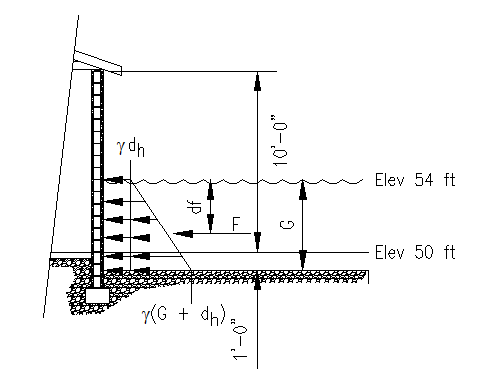
Referring to Figure 6.7.2.1, we can compute the various indicated quantities. The following calculations assume that the building is water tight, or that the flood level rises fast enough that there is a time when the water level in the building is insignificant when the BFE is reached.
Figure 6.7.2.1
Building Option 'A' Quantities
The magnitude of the triangular portion of the diagram was computed in example problem 6.1. We need to now compute the rectangular portion of the diagram. To do this we need to compute dh according to ASCE 7-10 equation 5.4-1. Before we can do that we need to compute the drag coefficient for each of the surfaces using the recommendations of the CCM Table 11-2.
The drag coefficient depends of the walls, depth to width ratio, which is different for the two basic wall sizes in our building. Once we find the drag coefficient we can then compute the dynamic pressure. With the pressure we can compute the force on the wall in terms of force per unit length of wall and in terms of total dynamic force on the wall. Finally we can add this to the hydrostatic force to get the total flood force on the wall.
For the long walls:
w/ds = 20 ft / 3.25 ft = 6.15
a = 1.25 (from CCM Table 11.2)
dh = (1.25) (6.75 fps)2 / 2 / 32.2 ft/s/s = 0.884 ft
gdh = (64.0 pcf) (0.884 ft) = 56.6 psf
Fdyn = (56.6 psf) (5 ft) = 283 lb/ft of wall length
Fdyn = (283 lb/ft) (20 ft of wall) = 5.66 kips on the whole wall
Ftotal = 283 plf + 800 plf = 1,083 lb/ft of wall length
Ftotal = 5.66 k + 16.0 k = 21.7 kips on the whole wall
For the short walls:
w/ds = 10 ft / 3.25 ft = 3.08
a = 1.25 (from CCM Table 11.2)
Note, that in this case, the drag coefficient is the same for both walls, which will lead to the same dynamic force per unit length of wall for all four walls.
dh = (1.25) (6.75 fps)2 / 2 / 32.2
ft/s/s = 0.884 ft
gdh = (64.0 pcf) (0.884 ft) = 56.6 psf
Fdyn = (56.6 psf) (5 ft) = 283 lb/ft of wall length
Fdyn = (283 lb/ft) (10 ft of wall) = 2.83 kips on the whole wall
Ftotal = 283 plf + 800 plf = 1,083 lb/ft of wall length
Ftotal = 2.83 k + 8.00 k = 10.83 kips on the whole wall
Another thing to consider is the net lateral force on the building so that sliding resistance can be provided. In this case, the net lateral force in each direction equals the dynamic force since the dynamic force is only applied on the upstream side (noting that the flood can come from any direction in a coastal zone). This means:
Net lateral flood force in the short direction (water on long
face) = 5.66 kips
Net lateral flood force in the long direction (water on the short face) = 2.83
kips
If you account for internal water at the still water level, the net overall force for sliding does not change since the internal force acts in all directions within the building and cancels itself out. However the inclusion of the internal water will reduce the design forces on the wall. The solution is similar to that found in example problem 6.1 (i.e. the internal forces are the same).
Option 'B' Building
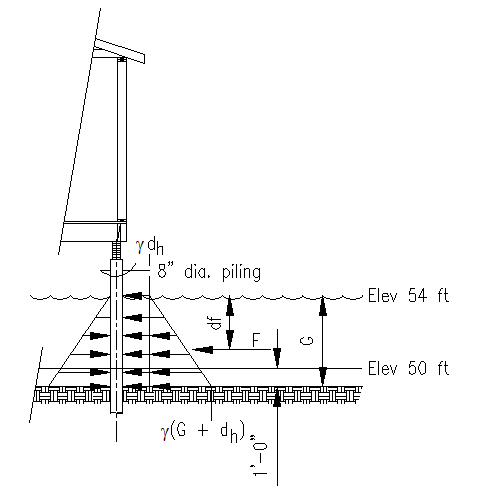
Refer to Figure 6.7.2.2. For this case we need to compute an new drag coefficient which will ultimately lead to a dynamic force on each pile. Notice that the hydrodynamic component is self canceling.
Figure 6.7.2.2
Building Option 'B' Quantities
a = 1.2 (see CCM 11.6)
dh = (1.75) (6.75 fps)2 / 2 / 32.2 ft/s/s = 0.849 ft
gdh = (64.0 pcf) (0.849 ft) = 54.3 psf
Fdyn = (54.3 psf) (5 ft) = 181 lb per pile
Fdyn = (181 psf) (6 piles) = 1,090 lb for the structure (any
direction)
Solution Summary:
Option A:
Option B:
------< 0 >------
Another interesting thing to do is consider the impact of a tsunami, which is a dynamic flow problem. The CCM suggest using twice the upper-bound velocity for the this situation.
For Building Option 'A' the impact is particularly huge. The additional dynamic depth goes from .884 ft to 8.13 ft, resulting in a dynamic pressure of 520 psf. This translates into a hydrodynamic force on the long face of 52 kips (up from 5.66 kips) and 26 kips (up from 2.83 kips) on the short face. These numbers don't include the hydrostatic forces also present.
For Building Option 'B' the hydrodynamic force also jumps dramatically but is still workable from a design standpoint. The load on each pile goes from 181 lbs/piling to 1,664 lb/piling. The overall force of 9.98 kips is high but still workable.