| Overview |
| IL for Reactions |
| IL for Shear |
| IL for Moment |
| Summary |
| Homework Problems |
| Report Errors or Make Suggestions |
Section IL.3
Qualitative Shear Influence Lines
Last Revised: 02/17/2026
Unlike the influence lines for reactions, there are technically an infinite number of locations along that beam for which shear influence lines can be derived. Typically, a few strategic locations are sufficient to identify where to place moveable loads.
Figure 5 shows influence lines for shear on spans left and right. It may be observed that the general shape of the influence lines do not change regardless of where “X” is chosen on each span.
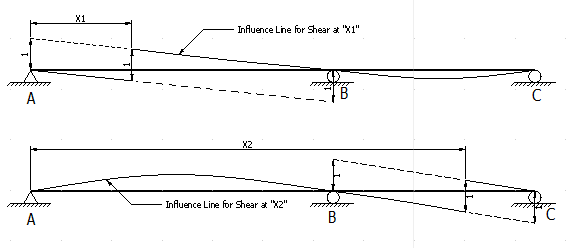
Figure 5: Influence Lines for Shear at X1 and X2
To find the influence line for shear, the beam is “cut” at the location of interest, and a unit shear deformation is imposed. Positive shear is generally defined as acting upward on the right side of a cut and downward on the left of cut. Note that the slope of the influence line is the same on each side of the cut.
To determine the maximum positive shear at X1, loads should be placed to the right of the cut on the left span and not extend onto the right span as shown in Figure 6.
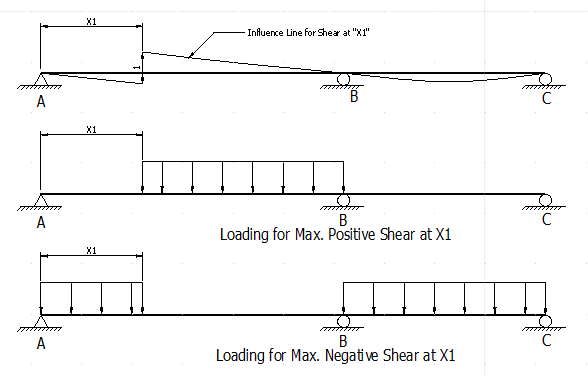
Figure 6: Loadings for Max. Positive and Negative Shear at X1
To determine the maximum negative shear at X1, loads should be placed to the left of the cut on the left span and anywhere on the right span as the influence line is negative in these regions.
To determine the maximum positive shear at X2, loads should be placed anywhere on the left span and from X2 to the end of the right span as the influence line is positive in these regions as shown in Figure 7.
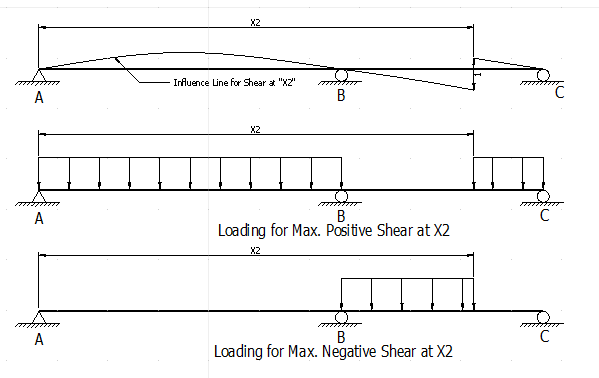
Figure 7: Loadings for Max. Positive and Negative Shear at X2
To determine the maximum negative shear at X2, loads should be placed anywhere from support “B” to X2 as the influence line is positive in these regions.